Wall Water Damage & Hidden Moisture Cleanup in Madison, AL
Wall water damage can occur after hidden plumbing leaks, roof or ceiling leaks, bathroom overflows, appliance leaks, water heater leaks, or water entering along floor edges and baseboards. Possible signs include staining, soft drywall, peeling or bubbling paint, swollen baseboards, localized dampness, and a musty odor as a possible clue. Madison Water Damage Restoration provides moisture detection, wall cavity evaluation, and structural drying for hidden water inside walls for properties in Madison, Alabama. Because water can remain inside wall cavities behind drywall and insulation long after the surface appears dry, professional moisture assessment may be needed. Madison property owners can call (256) 588-8480 to request hidden moisture cleanup.
How Do You Know If Water Is Behind a Wall?
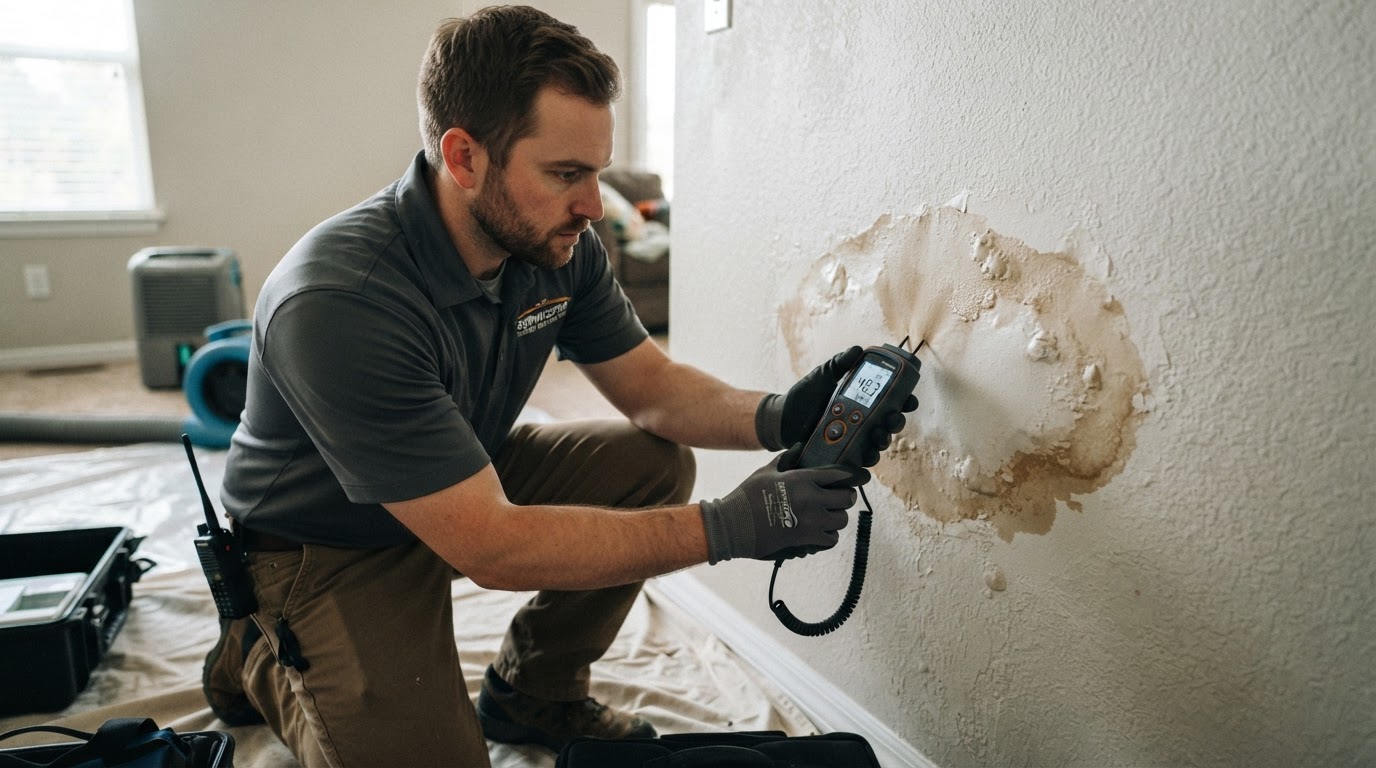
Visual signs such as staining, soft drywall, bubbling paint, swollen baseboards, or localized dampness can suggest water behind a wall, but moisture measurement is usually needed to understand the full affected area. A wall may look only slightly discolored while moisture remains inside the cavity, insulation, and framing. Moisture meters map the wall rather than relying on appearance alone. Call (256) 588-8480.
Common Sources of Hidden Wall Moisture Near Madison
Water inside a wall usually arrives from a source some distance away. By the time a stain or soft spot appears, moisture may have been present in the cavity for days or longer.
Pipe leaks and supply-line leaks inside wall cavities are frequent sources. A slow leak behind a wall can wet insulation and the back of the drywall with no visible water on the floor. Roof and ceiling migration sends water down framing and into wall cavities, and bathroom leaks from showers, tubs, or fixtures can reach the wall behind or beside the fixture. Dishwasher and refrigerator water can travel along floor edges and into the base of a wall, and water heater leaks can reach nearby walls.
HVAC condensate problems and water entering along floor edges or behind baseboards can also introduce moisture into wall assemblies. In each case, the water follows gravity and the path of least resistance, collecting at the bottom plate and wicking upward into drywall, insulation, and baseboards. The source is corrected by the appropriate qualified trade while Madison Water Damage Restoration addresses the wet wall materials.
Because these leaks are hidden, the extent depends on the leak location, duration, the materials involved, and gravity. A leak high in a wall can wet a large area as water runs down framing, while a leak at the base may saturate the bottom plate and lower drywall first.
- Pipe and supply-line leaks inside walls
- Roof and ceiling migration into wall cavities
- Bathroom shower and fixture leaks
- Dishwasher and refrigerator water at floor level
- Water heater leaks reaching nearby walls
- HVAC condensate problems
- Water entering along floor edges and baseboards
Can a Small Plumbing Leak Wet an Entire Wall Cavity?
It can, depending on the leak location, duration, materials, and gravity. A slow leak high in a wall can run down framing and wet insulation and drywall across a wide area before any sign appears. A leak at the base may saturate the bottom plate and lower drywall first. The extent is determined with moisture meters rather than by the size of the visible stain, because hidden moisture often extends beyond what is visible.
Wall Water Damage Evaluation and Structural Drying
Restoration moves from source control into moisture measurement, affected-area mapping, selective access where needed, and controlled drying. Walls are not always opened, and they are not always left closed — the approach depends on the water source, saturation, and material condition. Not every property requires every step.
Walls are not always opened, and they are not always left closed. Where moisture is trapped and cannot be dried through the surface, limited access may be used to reach the cavity. Where the wall can be dried in place, it is. Decisions depend on the water source, contamination, saturation, and material condition.
- 1
Source control
The active source is corrected by the appropriate qualified trade so water is not still entering the wall during cleanup.
- 2
Visual inspection
The wall is inspected for staining, soft drywall, bubbling or peeling paint, swollen baseboards, and localized dampness.
- 3
Moisture measurement
Moisture meters map the wall, the baseboards, and adjacent areas to find the full extent of wet materials behind the surface.
- 4
Affected-area mapping
The moisture readings define which sections of drywall, insulation, and framing are wet, so drying and any access are targeted rather than guesswork.
- 5
Water extraction where relevant
Where standing water is present at the base of the wall or in an accessible cavity, it is removed before drying begins.
- 6
Selective access if needed
Where moisture is trapped behind drywall and cannot be reached, limited access may be used to reach the cavity, insulation, and framing for drying.
- 7
Material evaluation and air movement
Wet materials are evaluated for salvage. Air movers and dehumidifiers are positioned to dry the remaining drywall, cavity, and framing.
- 8
Monitoring
Moisture is checked over time until the wall assembly reaches an appropriate dry standard, followed by final reassessment.
Water spreading through your property?
Fast action can help reduce additional water damage. Call Madison Water Damage Restoration now for water removal and drying assistance.
Where Water Can Hide Inside Wall Assemblies
A wall assembly contains several layers and cavities where water can remain after the surface looks dry.
Drywall absorbs water from behind and from its edges, and the paper facing can soften or bubble while the painted surface still looks intact. Insulation inside the stud cavity holds moisture against the drywall and the framing, and a stud cavity can retain water at the bottom where it collects along the bottom plate. Baseboards and the gap behind them are common paths for water to enter and exit the wall.
Cabinet backs, where a wall meets cabinetry, can hide moisture that traveled from a nearby leak. Electrical penetrations, in general terms, are gaps where water can move through the assembly, though electrical boxes should not be opened by anyone other than a qualified professional. Adjacent flooring and the subfloor edges at the base of the wall can take on water that ran down the wall and pooled at the floor.
Because these spaces are concealed, the visible stain rarely shows the full extent. Moisture meters check behind baseboards, into the stud cavity, and along the bottom plate rather than assuming the wall is dry based on its surface appearance.
- Drywall and its paper facing
- Insulation inside the stud cavity
- Stud cavities and bottom plates
- Baseboards and the gap behind them
- Cabinet backs at wall intersections
- Adjacent flooring and subfloor edges
Can Drywall Feel Dry While the Wall Cavity Is Still Wet?
Yes. The painted surface of drywall can feel dry while moisture remains in the insulation, stud cavity, and framing behind it. Water that entered the cavity can sit against the back of the drywall and the bottom plate without showing on the surface. Moisture meters check inside the cavity rather than relying on how the wall feels, because surface dryness does not confirm the assembly is dry.
Related Water Damage Services
Wall water damage cleanup is part of a hidden-water-damage cluster that includes ceiling water, under-floor moisture, and broader structural drying services.
Ceiling & Wall Drying
Learn moreBurst Pipe Cleanup
Learn moreStructural Drying
Learn moreRestoration
Learn moreRelated Water Damage Problems
Because wall moisture often connects to ceiling water and under-floor leaks, the ceiling water damage and wet drywall page covers water from above, and the slab leak and under-floor water damage page covers water entering walls from below. The broader roof leak, ceiling, wall, and hidden water damage page is the parent resource, and burst pipe and plumbing leak cleanup applies where a plumbing leak is the source. Madison Water Damage Restoration serves Madison and surrounding communities such as Huntsville, Athens, and Toney.
The related services, problem pages, and service-area links below connect to the rest of the water damage cluster. Use Contact Us to request hidden moisture cleanup and Home to return to the main site.
Wall Water Damage & Hidden Moisture Cleanup FAQs
Direct answers to common questions about this water damage problem in Madison, Alabama.
Think Water Is Hidden Behind a Wall?
Water can remain inside wall cavities behind drywall and insulation long after the surface looks dry. Call Madison Water Damage Restoration at (256) 588-8480 for wall water damage and hidden moisture cleanup in Madison, Alabama.