Slab Leak & Under-Floor Water Damage Cleanup in Madison, AL
Water below or beneath flooring may result from under-slab plumbing leaks, supply-line leaks, nearby plumbing failures, appliance leaks, bathroom leaks, water migrating from another room, or other hidden sources. Potential signs include unexpected damp flooring, warping, discoloration, loose flooring, water near baseboards, persistent dampness, and water appearing along floor seams. Madison Water Damage Restoration provides moisture assessment, water extraction, and structural drying for water beneath flooring in Madison, Alabama. The company handles the water damage cleanup, not the slab or plumbing leak repair itself. Madison property owners can call (256) 588-8480 to request under-floor water damage cleanup.
What Should You Do If Water Is Coming Up Through the Floor?
Avoid electrical hazards where water may contact wiring or outlets, stop the active water source if it can be done safely, and contact the appropriate plumbing professional for diagnosis of a possible under-slab or under-floor leak. Arrange water extraction and moisture assessment for the flooring, subfloor, and baseboards. Madison Water Damage Restoration handles the water cleanup, not the leak repair. Call (256) 588-8480.
Signs Water May Be Trapped Under Flooring
Under-floor water is deceptive because the flooring surface often hides the moisture beneath it. By the time signs appear, water may have been present beneath the floor for some time.
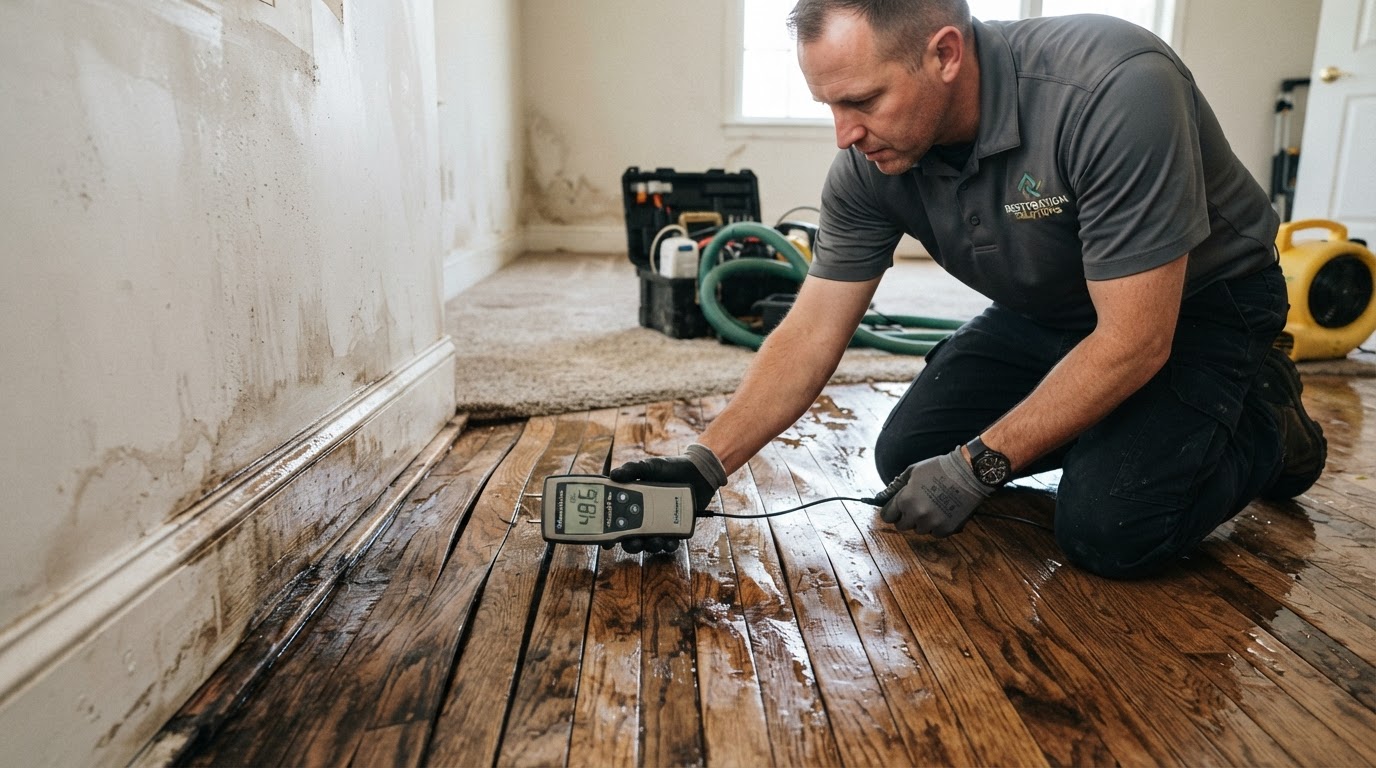
Warped wood and lifting flooring are common signs. Hardwood and engineered flooring can cup, crown, or buckle as moisture affects the underside, and laminate and vinyl can lift at the edges as water travels beneath them. Discolored grout, where tile is present, soft transitions, and wet baseboards can indicate water at the floor edge. Damp carpet and a wet pad beneath it can hold water that the surface only hints at.
Localized moisture and water appearing at seams are also common. Water beneath flooring often becomes visible at transitions, seams, or the perimeter where it meets baseboards, rather than across the whole floor. The source is not diagnosed from the symptom alone — a plumbing professional evaluates whether an under-slab or under-floor leak is the cause.
Water can travel far from a plumbing leak under the floor. It migrates along material interfaces, flooring assemblies, cracks, seams, and low points depending on the construction, so the visible damp area may be some distance from where the water entered.
- Warped, cupped, or buckling wood flooring
- Lifting laminate and vinyl at the edges
- Discolored grout and soft transitions
- Wet baseboards and water at the floor edge
- Damp carpet and a saturated pad
- Water appearing at seams and transitions
Can Water Travel Far From a Plumbing Leak Under the Floor?
Yes. Water from an under-slab or under-floor leak can migrate along material interfaces, flooring assemblies, cracks, seams, and low points, so the visible damp area may be some distance from where the water entered. The full extent is mapped with moisture meters rather than assumed from where the water first appears.
Under-Floor Water Cleanup and Structural Drying in Madison
Cleanup moves from source diagnosis into moisture measurement, water removal, material evaluation, and controlled drying. The approach depends on the water source, construction, materials affected, and extent of saturation. Not every property requires every step.
Not every slab leak requires demolition, and not all flooring can be saved. The decision depends on the water source, construction, material type, and condition. Some flooring and subfloor can be dried in place, while saturated or compromised materials may need removal to allow the structure beneath to dry.
- 1
Coordinate source diagnosis and correction
A plumbing professional diagnoses and corrects the under-slab or under-floor leak so water is not still entering during cleanup.
- 2
Determine the visible affected area
The flooring, baseboards, and adjacent walls are inspected for warping, dampness, discoloration, and water at seams.
- 3
Measure moisture
Moisture meters map the flooring, the subfloor beneath it, the baseboards, and the lower wall to find the full extent of wet materials.
- 4
Remove standing water where present
Extraction equipment removes standing water from the floor surface and any low areas where it has collected.
- 5
Extract from accessible materials
Where water has reached beneath flooring or into carpet and pad, extraction targets those accessible materials before drying begins.
- 6
Evaluate flooring, subfloor, and baseboards
Flooring, the subfloor, and baseboards are assessed for salvage. Some materials can be dried; saturated or compromised materials may need removal.
- 7
Use drying and dehumidification where appropriate
Air movers and dehumidifiers are positioned to dry the remaining flooring, subfloor, and lower wall, with attention to concealed spaces beneath the floor.
- 8
Monitor conditions
Moisture is checked over time in the flooring, subfloor, and baseboards until materials reach an appropriate dry standard.
Water spreading through your property?
Fast action can help reduce additional water damage. Call Madison Water Damage Restoration now for water removal and drying assistance.
What Materials Can Be Affected by Under-Floor Water?
Under-floor water can affect a range of materials, and the construction of the floor — concrete slab or raised subfloor — shapes how water moves and what can be dried.
Hardwood, laminate, and vinyl flooring can cup, buckle, or lift as moisture affects the underside, and carpet and pad can hold a large amount of water beneath the surface. Tile assemblies, depending on their condition and the grout and underlayment, can allow water to reach the subfloor beneath. The subfloor, where present, can absorb water that passes through the finished floor.
Baseboards, drywall at floor level, cabinet bases, and wall bottom plates can take on water that traveled from beneath the floor to the perimeter. The differences between concrete slab construction and raised or subfloor construction matter: water beneath a slab may travel along the slab surface or through cracks, while a raised subfloor may allow more access for drying. Neither one specific construction method is assumed.
Because the water sits beneath the surface, flooring can look dry while water remains underneath. Moisture meters check beneath the flooring and into the subfloor rather than relying on the surface appearance.
- Hardwood, laminate, and vinyl flooring
- Carpet and pad
- Tile assemblies, conditionally
- Subfloor where present
- Baseboards and drywall at floor level
- Cabinet bases and wall bottom plates
Can Flooring Look Dry While Water Is Still Underneath?
Yes. The flooring surface can look and feel dry while water remains beneath it in the subfloor, pad, or along the slab. Water beneath flooring often hides at seams, transitions, and the perimeter where it meets baseboards. Moisture meters check beneath the surface rather than relying on appearance, because surface dryness does not confirm the materials underneath are dry.
Related Water Damage Services
Under-floor water damage cleanup is part of a plumbing-leak and hidden-water cluster that includes wall moisture, crawl-space drying, and kitchen and bathroom leak sources.
Burst Pipe Cleanup
Learn moreRestoration
Learn moreStructural Drying
Learn moreWater Extraction
Learn moreRelated Water Damage Problems
Because under-floor water often connects to wall moisture and crawl-space construction, the wall water damage and hidden moisture page covers water that reached the walls, and the crawl space water damage page covers moisture beneath raised construction. The broader burst pipe and plumbing leak cleanup page is the parent resource, and structural drying applies to the remaining materials. Madison Water Damage Restoration serves Madison and surrounding communities such as Huntsville, Athens, and Toney.
The related services, problem pages, and service-area links below connect to the rest of the water damage cluster. Use Contact Us to request under-floor water damage cleanup and Home to return to the main site.
Slab Leak & Under-Floor Water Damage Cleanup FAQs
Direct answers to common questions about this water damage problem in Madison, Alabama.
Water Appearing From Under Your Flooring?
Water beneath flooring can hide in the subfloor and at the baseboard line long after the surface looks dry. Call Madison Water Damage Restoration at (256) 588-8480 for slab leak and under-floor water damage cleanup in Madison, Alabama.